Showing posts with label information. Show all posts

Friday, 4 December 2009

Procession for the Immaculate Conception


A Torchlight Procession in honour of Mary Immaculate to take place in Rome on 8th December, 2009, at 7 p.m., for the feast of the Immaculate Conception. The pilgrim statue of Our Lady of Fatima will be carried n the Torchlight Procession 'aux flambeaux,' through the Via del Corse, presided over by a Cardinal.

The procession will leave the Church of Gesù e Maria at 45, Via del Corso, (in front of San Giacomo) and will arrive at 8 p.m. at the Basilica of Santa Maria sopra Minerva for Benediction of the Blessed Sacrament.

Information can be obtained from Canonico Don Giuseppe Luzuy of the Institute of Christ the King, Sovereign Priest:

Tel./fax: 06 66 24 922
Cell: 335 345 163
e-mail: roma@icrsp.org

Saturday, 7 November 2009

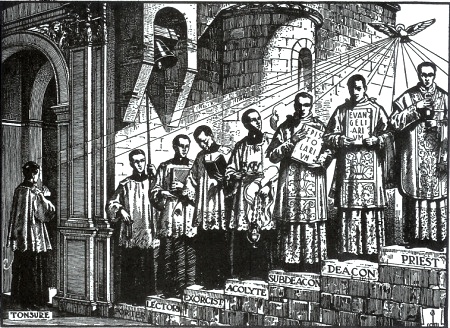
The Minor Orders

by Scott Arbuckle, Una Voce Carmel

sevenorderssc1

The minor orders are the lower degrees of the ecclesiastical hierarchy, in contrast to the “major” or “sacred” orders. In the Latin Church, there are four minor orders: porter, lector, exorcist, and acolyte. They are all mentioned in a letter of Pope Cornelius to Bishop Fabius of Antioch in A. D. 252. More recently, the Council of Trent of July 15, 1563 said of the minor orders and subdiaconate:

... From the very beginning of the Church the names of the following orders and the duties proper to each one are known to have been in use, namely those of the subdeacon, acolyte, exorcist, lector, and porter, though not of equal rank; for the subdiaconate is classed among the major orders by the Fathers and the sacred Councils, in which we also read very frequently of the other inferior orders (D.958).

Minor orders are conferred by the presentation to the candidate of the appropriate instruments of his office, in accordance with the ritual given in the Satuta Ecclesiæ antiqua, a document which originated in Gaul about the year A.D. 500. This ritual was later introduced in Rome. By the ordination to any of the 4 minor orders, the recipient receives official authority to perform the liturgical functions of this office.

Porter or doorkeeper (ostiarius in Latin; from the word ostium, a door), denoted among the Romans the slave whose duty was to guard the entrance of the house. From the end of the second century, the Christian communities began to own houses for holding church services. Church doorkeepers were found at least in larger cities. The texts of the ritual clearly express the duties of the porter as well as the virtues he must practice, especially zeal for the house of God.

Lector is someone who is sufficiently educated to be able to read publicly the Sacred books in the Church. The text of the ritual requires from the lector clear and precise diction as well as the understanding of the words of Sacred Scripture. The first mention of a Christian liturgical reader is by St. Justin, who died a Martyr, in A.D. 165.

The word Exorcist finds its origin in the Greek language. In general, it refers to anyone who casts out or professes to cast out demons. IN particular, It refers to him who is ordained or appointed to this office by the bishop. IN the early ages of the Church, this function was not confined to clerics. But with the development of the rites of baptism (since catechumens had to be exorcized every day by an imposition of hands), some clerics were specially appointed o this office. Currently only priest are authorized to use the exorcizing power conferred by this ordination. In each diocese, the local bishop appoints a priest to the special task of casting out demons from the possessed.

Acolyte, in Greek, means someone who follows, who attends. The chief duties of an acolyte are to light the candles on the altar, to carry them in procession and during the solemn singing of the Gospel. He is also in charge of preparing the wine and water for Mass. Unlike the other minor orders, the ritual of the ordination of acolytes ends with three prayers of blessing instead of one. This underscores the importance of the minor order of Acolyte, the last step before the “sacred” or “major” orders.

Since 1972, minor orders are no longer conferred in the Latin Rite, except in those communities where the 1962 liturgical books are in use.

~~*~~

Monasteries and Orders who observe Minor Orders:

(reposted from Una Voce Carmel)

Friday, 19 June 2009

The Dominican Sisters of the Holy Ghost

One of the powerhouses of traditional Catholic culture in France for several decades and one of the first feminine Latin Mass congregations in union with the Holy See, the Domincan Sisters 'of Pontcalec' have, at long last, launched an internet site.

The Dominican Sisters of the Holy Ghost is a Congregation of Pontifical Right within the Dominican Order.

In imitation of St. Catherine of Siena, and following an ancient form of Dominican Religious life that had disappeared from France since the Revolution, the Sisters are simply consecrated Dominican Virgins.

The Community Office is celebrated in Latin according to the Extraordinary Form of the Roman Rite.

As the Constitutions of the Congregation state: "Since the institute belongs to the Order of St. Dominic, where we seek holiness in the contemplation and the transmission of divine truth, the sisters must apply according to their ability to diligent studies in order to penetrate only the truth and teach only the truth."

In the spirit of those Constitutions, the Sisters run six schools in France: Notre Dame de Joie (Pontcalec, Brittany), St. Thomas (Pontcalec, Brittany), St. Catherine (Nantes, Brittany), St. Pius X (St. Cloud, near Parish), St. Dominic (La Baffe, Lorraine), and St. Joseph (Draiguignan, Cote d'Azur).

The Sisters can be contacted by writing to:

Rev. Mère Marie-Geneviève,
Prieuresse,
Couvent Notre-Dame-de-Joie,
56240 Berne,
FRANCE.

Or by telephone to: +33 2 97 36 62 03

Thursday, 9 October 2008

Website of the Ecclesia Dei Commission Online

by Gregor Kollmorgen


The Pontifical Commission Ecclesia Dei now has an official website called Summorum Pontificum. The address is www.ecclesiadei-pontcommissio.org. So far it is mainly in Italian, but versions in English, German, Spanish, French and Portuguese are apparently being prepared. This is Card. Castrillón's introductory letter (click to enlarge):


NLM translation:

To the end of keeping bishops, priests, religious and faithful permanently informed about every aspect concerning the Extraordinary Use of the Roman Rite and every expression of the Gregorian liturgy, on this Solemnity of the Holy Apostles Peter and Paul, the Pontifical Commission Ecclesia Dei inaugurates the "web" site Summorum Pontificum.

We will strive to incorporate into the structure of this website official documents, study material, information about events, comments and audiovisual instruments helpful for the understanding and performing of the liturgical celebrations.

We do not aim in any way at establishing an interactive website, but rather at offering information and materials in complete fidelity to the "mens" of the Holy Father, who has manifested the clear intention of preserving and keeping alive, in extraordinary form, the theological, spiritual, religious and artistic richness of the Gregorian Liturgy.

(Hat-tip for the link to the Spanish blog Hoc Signo.)

(reposted from The New Liturgical Movement)

Friday, 5 September 2008

Age limits

A reader asks:

What is the age limit for traditional vocations? I have heard of gentlemen up to 75 being admitted, but I think many are in their 40's and 50's these days. Though, I am hearing of many in their 40's and 50's being denied, too, from the Texas dioceses. Also, there are dioceses which preclude men from entering the seminary if they have been divorced.

Are you able to help? I know the FSSP, for example, has a general age limit of 35 years, but will consider individuals over that on a case-by-case basis.

Sunday, 20 July 2008

Can you help us?

“What earlier generations held as sacred, remains sacred and great for us too, and it cannot be all of a sudden entirely forbidden or even considered harmful. It behooves all of us to preserve the riches which have developed in the Church’s faith and prayer, and to give them their proper place…”

– Pope Benedict XVI in his Letter accompanying Summorum Pontificum

For five months now this Traditional Vocations blog has been featuring Traditional societies and religious orders using the Extraordinary Form of the Roman Rite. We need your assistance to continue this.

In particular, there are many Traditional societies, institutes and religious communities which are not listed here, mainly because we cannot locate information about them in English. Could you translate materials about them out of their original languages and into English?

Alternatively, if you know of communities not featured here, with information in English, then please do comment!

Here are some other things you can do to help:

Spread the word!
  • Can you feature this site on your blogs? Or ask your friends to do the same?
  • Would your Parish or Diocese feature this in a newsletter, on a website? Would you ask them?
  • Are there other websites we should be featured on, or linked from?
Be our eyes and ears
  • Is there content we ought to feature? If so, tell us!
  • Do you have information on courses of studies in various seminaries, entrance requirements, website links?
  • Have you personal experience of one of the communities featured here? Share your experiences with us!
And remember, if you know others discerning their vocations, point them this way! May the Lord send us more holy Priests, monks and nuns than we can know what to do with!

Friday, 27 June 2008

new FSSP Seminary website and FAQ


The FSSP's Our Lady of Guadalupe Seminary has revamped their website, and there is now a Frequently Asked Questions included.

Check it out at www.fsspolgs.org.

Tuesday, 1 April 2008

How you can help

Here are some things you can do to help:

Spread the word!
  • Can you feature this site on your blogs? Or ask your friends to do the same?
  • Would your Parish or Diocese feature this in a newsletter, on a website? Would you ask them?
  • Are there other websites we should be featured on, or linked from?
Let us know! After all, these blogs are to encourage Vocations, so people need to see them!

Translation
  • Could you translate materials about the societies, institutes and religious communities listed here out of their original languages and into English?

Be our eyes and ears
  • Is there content we ought to feature? If so, tell us!
  • Do you have information on courses of studies in various seminaries, entrance requirements, website links?
  • Have you personal experience of one of the communities featured here? Share your experiences with us!
Oh, and if you know others discerning their vocations, point them this way! May the Lord send us more holy Priests, monks and nuns than we can know what to do with!

Saturday, 29 March 2008

Vocations and the Traditional Latin Liturgy

Ad Deum qui lætificat juventutem meum!

“…Immediately after the Second Vatican Council it was presumed that requests for the use of the 1962 Missal would be limited to the older generation which had grown up with it, but in the meantime it has clearly been demonstrated that young persons too have discovered this liturgical form, felt its attraction and found in it a form of encounter with the Mystery of the Most Holy Eucharist, particularly suited to them…”

“What earlier generations held as sacred, remains sacred and great for us too, and it cannot be all of a sudden entirely forbidden or even considered harmful. It behooves all of us to preserve the riches which have developed in the Church’s faith and prayer, and to give them their proper place…”

– Pope Benedict XVI in his Letter accompanying Summorum Pontificum


Say what?

Catholics are a fairly consistent bunch. The way Catholics said Mass for Centuries was almost identical. If you looked at a Missal from 601 AD, you’d see virtually the same central text (the Roman Canon) as in the Missal from 1962. The Missals of 1471 and 1962 are largely identical. So what? So there’s something in there that a lot of folk, over a lot of centuries, thought was worth preserving. We think so too. Like the Pope says: “It behooves all of us to preserve the riches which have developed in the Church’s faith and prayer.” Maybe you agree?


So what has the Traditional Latin Liturgy to offer me?
Truth, Beauty, Goodness. Good start. “The most beautiful thing this side of Heaven,” someone called the Traditional Latin Liturgy. Add authenticity – why don’t we have Baptisms like they had in The Godfather anymore? Throw in some Gregorian Chant – not just music-to-relax-while-you-drive but an integral part of the Traditional Latin Liturgy(1).

That’s the wrapping but what about the substance? Inside you have a tried-and-tested spirituality based upon the centrality of Christ and the personal relationship of each individual with Him. It’s been a winning combination for ages! Maybe it’ll do it for you?


Do people really still do this stuff (outside a film set)?

They do – they do it for real – they do it for life! Since John Paul II appealed for generosity towards the Traditional Latin Liturgy back in 1988, Traditional Seminaries, Monasteries, Convents have been springing up – and filling up with young people – all over the world.

The Fraternity of Saint Peter for Priests opened its second Seminary, Our Lady of Guadalupe, in Nebraska, USA, in 2000, with 50 Seminarians and reached capacity a few years later.


Get real! We can’t even get Priests for Mass in English!

Get with the programme! Like the Pope said: “…What earlier generations held as sacred, remains sacred and great for us too…” “Dougal, you know you can praise the Lord with Latin too?” (Fr. Ted… sort of) If it works, don’t knock it. Maybe the Traditional Latin Liturgy works for you? Give it a try!


So you’re saying there’s a future in the past?

Not exactly – but even after 1500 years, there’s still plenty of future in the Traditional Latin Liturgy. It’s here to stay and it aims to inspire. It has inspired millions for millennia. Maybe it can inspire you?

1 - Fr. F.W. Faber, Cong. Orat., collaborator of Ven. John Henry, Cardinal Newman.